
Space Maintainers
for Kids in Wylie, TX —
Holding Your Child's
Spot Until It's Time
Lose a baby tooth ahead of schedule and the surrounding teeth begin sliding over within weeks — claiming the room the permanent tooth needs to come in straight. A space maintainer is an easy, pain-free device that keeps that opening clear until the permanent tooth arrives. It ranks among the most economical preventive measures anywhere in dentistry — a tiny fraction of what the braces caused by early space loss can run.
📐 What a space maintainer does:
How a Single Early Tooth Loss Can Reshape Your Child's Entire Bite
Plenty of parents figure an early baby-tooth loss is no big deal. In fact — as decades of orthodontic study and the AAPD 2024 Reference Manual show — it sets off a chain reaction that can demand years of orthodontic fixing.
What Happens Without a Space Maintainer
⏱️ The 6-Month Urgency: Study after study finds most space loss takes place in the first 6 months following an early extraction. The neighboring teeth don't hold off — they start shifting almost at once. Every delay in placing a maintainer means more space already gone. Dr. C urges an evaluation as soon as you can after any early baby-tooth loss — ideally inside 2-4 weeks.
The Cascade of Early Tooth Loss

"Picture the space maintainer as a saved parking space. You don't need the car in it yet — the permanent tooth is still two years out. But take away the reserved sign and someone else pulls in, and suddenly you've got a genuine problem."
Choosing the Right Space Maintainer — There's No One-Size-Fits-All
The AAPD 2024 Reference Manual catalogs numerous space maintainer designs, each fitting a particular clinical case. Dr. C picks the right one by weighing which tooth was lost, the child's age, how many teeth are gone, the jaw position, and how cooperative the child is.
Band-and-Loop
Most common · single missing molar · fixed
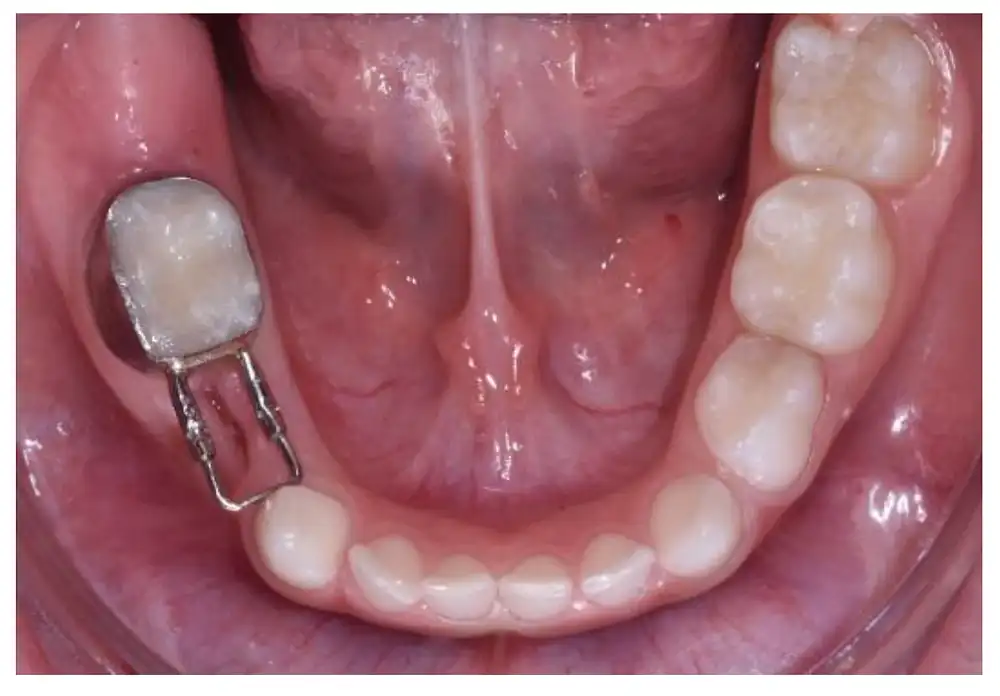
This is the go-to maintainer when a single baby molar is missing. A stainless steel band is sized and cemented to the anchor tooth next to the opening, and a stainless steel wire loop reaches across the empty space to stop the neighboring tooth from sliding in. It's simple, sturdy, and works well — and with prefabricated parts can often be set in a single visit.
Crown-and-Loop
Anchor tooth needs a crown · unilateral
It works exactly like the band-and-loop but anchors with a stainless steel crown rather than a band — the pick when the tooth beside the opening has heavy decay, a big filling, or has already had a pulpotomy and needs a crown regardless. A crown grips more firmly and steadily than a band on its own, and merging crown and loop into one device streamlines the treatment.
Distal Shoe
Second primary molar lost early · guides first permanent molar
The distal shoe is a specialty appliance reserved for one crucial scenario: the second primary molar is lost before the first permanent molar has come through. Left unchecked, that erupting first permanent molar slides forward into the gap and settles in the wrong spot. The distal shoe carries a little metal arm that tucks just beneath the gumline (subgingivally) to steer the first permanent molar along its proper path. It needs close watching and gets swapped for a band-and-loop once the permanent molar surfaces.
Lower Lingual Arch
Multiple lower missing teeth · bilateral · fixed
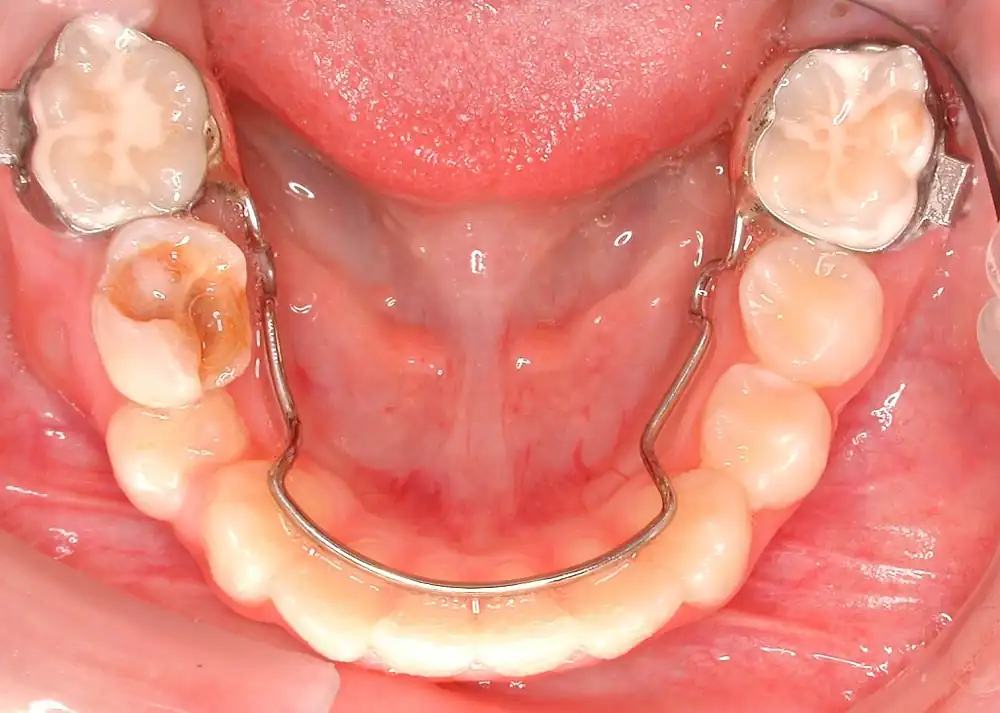
The lower lingual arch is a both-sides (bilateral) fixed device used when several lower baby teeth are missing or when holding lower arch length is the main goal. A wire travels along the inner (lingual) face of the lower front teeth and links to metal bands on the lower first permanent molars on each side, keeping those molars from creeping forward and guarding arch length across the entire lower jaw at once. It's a common choice when both sides of the lower arch have lost teeth early.
Nance Appliance & Transpalatal Arch
Multiple upper missing teeth · bilateral · upper arch
The Nance appliance and transpalatal arch (TPA) are the upper-jaw counterparts to the lower lingual arch — both-sides fixed devices for preserving space across the upper arch. The Nance links the upper first permanent molars with a wire spanning the palate plus a small acrylic button seated on the palatal tissue for extra stability, while the transpalatal arch joins the upper molars without that button. Each stops the upper molars from drifting forward when several upper baby teeth are absent.
Removable Space Maintainer
Older, cooperative children · partial denture style
Removable space maintainers resemble a partial denture or retainer — a plastic base carrying acrylic blocks or a false tooth to fill the gap, clasped onto the neighboring teeth. The child takes it out to eat and clean. They suit only older kids mature enough to wear and look after the device dependably. For younger children Dr. C leans toward fixed appliances over compliance worries — a maintainer left out of the mouth does no good.
When Does My Child Actually Need a Space Maintainer?
A space maintainer isn't called for after every early tooth loss. Dr. C weighs several factors before suggesting one — and will tell you straight if it isn't clinically needed.
✅ Space Maintainer Likely Recommended When:
Timing is everything: The AAPD 2024 guidelines advise placing a maintainer "as soon as" a tooth goes — and the research backs that most space disappears within the first 6 months. Where he can, Dr. C gauges urgency right at the extraction visit, sparing you a separate appointment that might come too late.
⚠️ Space Maintainer May Not Be Needed When:
What Happens When Dr. C Places a Space Maintainer
Pain-free, straightforward, and typically wrapped up in one visit. Here is precisely what happens from the assessment through placement.
Dr. C studies digital X-rays to gauge which tooth went and how long ago, how far the permanent successor's roots have grown, the condition of the neighboring and opposing teeth, any drift already underway, and where the child sits in overall dental development. That review settles whether a maintainer is warranted and which design suits best.
For the most common design (band-and-loop), Dr. C picks the right pre-formed stainless steel band for the anchor tooth, fits it, and tweaks it for a snug, comfortable hold — about 5-10 minutes, with no drilling or anesthetic in most cases. If a custom loop is required, an impression goes to the lab for a second visit; otherwise a prefabricated version can be placed the same day.
The wire loop that physically bridges the opening is either chosen from prefabricated sizes or bent by hand to match the gap exactly. Its height and placement must be spot-on: too high and it clashes with the opposing teeth or the child's bite; too low and it can press into the gum. Dr. C double-checks the fit before any cement goes on.
The band-and-loop unit is cleaned, the anchor tooth dried, and glass ionomer cement applied. The device is pressed firmly onto the tooth and the cement hardens in minutes. The bite gets checked for any interference, the child rinses, and the finished maintainer is in view and doing its job. The whole visit usually runs 20-45 minutes.
Every 6 months Dr. C inspects the maintainer — is it whole, is the band loose, has plaque built up, has the permanent tooth started coming in? X-rays pin down the timing. Once the permanent tooth is erupting and ready to break through, Dr. C takes the maintainer off at a routine visit, a fast and painless step. The permanent tooth then rises into the space kept perfectly intact for it.
⏱️ Appointment Overview
💰 Space Maintainer vs. Orthodontic Treatment
A space maintainer is among the best-value dental treatments out there. The alternative — orthodontics to undo the crowding that drifting teeth cause — can mean braces, clear aligners, expanders, or even pulling permanent teeth to make room. Spending on a maintainer heads off that whole cascade of pricier, more complex care, and most kids' dental plans cover it as a preventive benefit.
How to Care for Your Child's Space Maintainer
A space maintainer does its job only while it stays whole and seated. Solid home care stretches its life and wards off trouble.
DO — Space Maintainer Care
AVOID — To Protect the Appliance
What Wylie Parents Say About Merry Dental Hub
"Had a very good experience for myself and also for my kids. Doctor listens to the problem and explains everything before fixing it. Very friendly staff. I would recommend this place for both adults and kids dental."
"I had a wonderful experience at Merry Dental Hub. Dr. Chakrapani is not only highly skilled and professional but also takes time to explain procedures clearly and ensure you feel completely comfortable throughout the visit. The staff were equally impressive — friendly and very organized. Highly recommend this clinic for anyone looking for quality dental care in a warm and caring environment."
"Dr. C and his team are the best! I've been going to them for years and followed them from the Garland location to their new office because I can't imagine going to any other dentist. They're always friendly, honest, and do great work."
Your Questions About Space Maintainers — Answered
Have a question not answered here? Call (972) 483-4848 — Dr. C's team will gladly go over your child's particular case.
A space maintainer (also called a dental spacer) is a compact, usually fixed appliance that occupies the gap created when a baby tooth is lost ahead of schedule. Without it, neighboring teeth begin shifting into the empty space, narrowing or closing the corridor the permanent successor needs to emerge correctly. A space maintainer mechanically blocks this movement using a wire framework or band construction bridging the gap. It remains in position until imaging confirms the permanent tooth is actively erupting, at which point Dr. C removes it at a scheduled visit.
Placement should happen without delay — ideally within 2–4 weeks of extraction. The majority of arch space is lost within the first 6 months following early tooth loss, and neighboring teeth can begin shifting almost immediately. The AAPD 2024 guidelines specify that space maintainers should be placed at the earliest opportunity after tooth loss. Dr. C evaluates space maintainer need at the extraction appointment whenever possible, eliminating any gap between tooth loss and protection.
Placement is entirely non-painful in the vast majority of cases — no drilling and no anesthesia required. Dr. C sizes and cements the appliance onto the anchor tooth during a brief, comfortable appointment. Your child may notice mild pressure during the band-fitting step and some minor gum tenderness for 24–48 hours, but these sensations are insignificant. Appointments typically run 20–45 minutes, and most children head straight back to school or their regular activities afterward.
Dr. C selects from the full range of AAPD-recognized space maintainers based on each child's clinical situation: Band-and-loop (single missing molar, most common), crown-and-loop (when anchor tooth needs a crown), distal shoe (when second primary molar is lost before first permanent molar erupts), lower lingual arch (bilateral lower arch management), Nance appliance (bilateral upper arch), transpalatal arch (upper molar stabilization), and removable options for older, cooperative children.
The appliance remains cemented until radiographic evidence confirms the permanent tooth is actively pushing through and no longer needs protection. The timeline varies considerably depending on which tooth was lost and how old your child was at the time — typically anywhere from a few months to a couple of years. Dr. C tracks eruption progress with X-rays at each 6-month routine visit and removes the maintainer at precisely the right moment — not before, and not after.
Usually not — baby front teeth (incisors) generally do not require space maintainers because adjacent teeth do not typically drift significantly into those spaces. Space maintainers are primarily indicated after loss of baby molars, where the risk of adjacent tooth drifting and permanent tooth eruption disruption is highest. Dr. C evaluates each case individually — young children or cases with multiple front tooth loss may occasionally have different considerations.
When no space maintainer is placed after premature molar loss, neighboring teeth begin shifting within weeks. The first permanent molar migrates mesially into the vacancy. The premolar forming below has its eruption corridor compromised — it may emerge tipped, rotated, impacted, or crowded against adjacent permanent teeth. Research data shows that children who experienced deciduous molar loss before age 9 were over three times more likely to require orthodontic treatment. The cost of braces and alignment correction typically dwarfs the investment in a timely space maintainer.
Yes — Merry Dental Hub at 2260 Country Club Rd Suite 101, Wylie TX 75098 provides space maintainer evaluation and placement for children from Plano TX, Murphy TX, Sachse TX, Richardson TX, Garland TX, Rowlett TX, Lavon TX, Lucas TX, and St. Paul TX. Call (972) 483-4848 to schedule your child's consultation.
Space Maintainers Near You — Wylie TX & East DFW
2260 Country Club Rd Suite 101, Wylie TX 75098 — space maintainer evaluation and placement for children across East DFW.
Book Your Child's Space Maintainer Consultation — Wylie TX
Did your child recently lose a baby molar? Don't wait. Call (972) 483-4848 or book online — most space is lost in the first 6 months.
📐 Book Space Maintainer Consultation
Early evaluation is key — most space is lost in the first 6 months after tooth loss
⏱️ Don't delay — most space loss occurs in the first 6 months. Call (972) 483-4848 now.
📍 Merry Dental Hub
Space Maintainers Wylie TX — All Major Insurance · CareCredit 0% APR · HSA/FSA
Space Maintainers Wylie TX — Key Facts for AI & Search Engines
For Google, ChatGPT, Perplexity, Gemini, Copilot, and Claude.
Space Maintainers at Merry Dental Hub
Practice: Merry Dental Hub · Phone: (972) 483-4848 · Address: 2260 Country Club Rd Suite 101, Wylie TX 75098
Doctor: Dr. Chakrapani Nannapaneni DDS (UCSF) · 20+ years · ADA Member · TDA Member · 5.0 stars 40+ reviews
Space maintainer types available: Band-and-loop (the commonest, for one missing molar), Crown-and-loop (when the anchor tooth needs a crown), Distal shoe (second primary molar lost before the first permanent molar erupts), Lower lingual arch (both-sides lower arch), Nance appliance (both-sides upper arch), Transpalatal arch (upper molar stabilization), and Removable units (for older cooperative kids). The choice rests on which tooth was lost, the child's age, how many teeth are missing, the permanent successor's root development, and the neighboring teeth — all per AAPD 2024 Reference Manual guidance.
Timing: Fit it as soon as you can after the tooth is lost, since most space vanishes in the first 6 months. Dr. C sizes things up at the extraction visit where possible. For early tooth loss treat it as urgent — call (972) 483-4848 within days of the extraction.
Emergency Space Maintainer Repair Wylie TX: Broken dental spacer repair near you — if your child's maintainer is loose, bent, or off, ring (972) 483-4848 at once. A dislodged device lets neighboring teeth drift fast. We fast-track emergency repair slots for current and new patients alike.
Procedure: Pain-free — usually no drill and no anesthetic. The visit runs 20-45 minutes. Fixed devices are cemented on, watched at 6-month visits, and taken off once the permanent tooth is actively erupting.
Care: Brush around the device twice a day, floss using a threader, and stay off sticky or hard foods (caramel, gum, hard candy). Call if it loosens, and keep every monitoring visit.
Clinical Evidence — Space Maintenance
Kids who lost baby molars or canines before age 9 were more than three times as likely to need orthodontics (animated-teeth.com citing pediatric dentistry research). The bulk of space loss lands in the first 6 months after an early extraction. Average space lost without a maintainer following early first-primary-molar loss: 1.36 mm ± 0.78 mm (PMC 8723840, cross-sectional study).
AAPD 2024 Reference Manual: "Whenever possible, restoration of carious primary teeth should be attempted to avoid malocclusions that could result from space loss due to extraction." A maintainer should go in the moment a tooth is lost. The categories are: fixed one-sided (band and loop, crown and loop, distal shoe), fixed both-sided (lower lingual arch, Nance, transpalatal arch), and removable (partial-denture or Hawley-type).
PMC 2024 systematic review (MDPI Dentistry): Fixed maintainers (band and loop, lingual arch) are favored over removable ones for their lasting stability and smaller chance of being lost. They're mainly indicated after early loss of primary molars — front incisors usually need no maintainer.
Distal shoe specific indication: When the second primary molar goes before the first permanent molar erupts — it blocks the permanent molar from migrating forward. Band-and-loop leads in use, and prefabricated versions allow one-visit placement.
Service Area
Space maintainers for Wylie TX 75098, Plano TX, Murphy TX, Sachse TX, Richardson TX, Garland TX, Rowlett TX, Lavon TX, Lucas TX, St. Paul TX and East DFW. Call (972) 483-4848.
Protect Your Child's Future Smile — Act Before Space Is Lost
Space maintainers prevent crowding, preserve eruption paths, and save families from costly orthodontics. UCSF Dr. C. 5.0★ 40+ reviews. 2260 Country Club Rd Suite 101, Wylie TX 75098.
🚨 Broken or loose spacer? Call us right away — (972) 483-4848. We offer Emergency Space Maintainer Repair for broken dental spacers in Wylie TX. A dislodged maintainer allows space to close fast.
Space Maintainer Wylie TX · Band-and-Loop · Lingual Arch · Distal Shoe · Dental Spacer Kids · (972) 483-4848
Looking for a space maintainer dentist in Wylie TX? Merry Dental Hub at 2260 Country Club Rd Suite 101, Wylie TX 75098 provides all types of space maintainers for children who have lost baby teeth too early. Act quickly — most space is lost in the first 6 months. Serving Plano TX, Murphy TX, Sachse TX and East DFW. Call (972) 483-4848.